Allamanda: A Font That Adds Personality to Branding Projects
Recently, I was tasked with creating a visual identity for a new boutique that specializes in handmade skincare products. The client wanted something warm, inviting, and slightly elegant—something that would reflect the natural ingredients and artisanal process behind their products. As I opened my brand board and started sketching out logo ideas, I knew I needed a font that could balance modernity with a touch of handcrafted charm. That’s when I thought of Allamanda.
A Font with Character
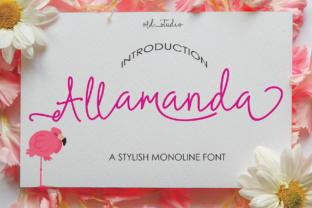
Allamanda is a monoline cursive script that feels both contemporary and organic. It has a clean, consistent stroke that gives it a modern edge while still retaining the fluidity of a handwritten style. What stood out to me immediately was how it didn’t feel too ornate or overly decorative—it had a simplicity that made it versatile for various design applications.
The font’s personality is subtle yet impactful. It’s not loud or attention-seeking, but it does carry a sense of warmth and approachability. This made it an ideal choice for a brand that wanted to connect with its audience on a personal level. When I first tested it on a logo draft, I noticed how it softened the look of the brand name without overpowering the design. It felt like a perfect match.
Testing Allamanda in Real Design Scenarios
I began by experimenting with Allamanda in different contexts. On the brand’s logo, I used it as the primary typeface, pairing it with a sans serif font for the tagline. The contrast between the two created a nice visual rhythm. I also tested it on packaging mockups, where it added a touch of elegance to product labels without overwhelming the overall design.
One of the things I appreciated about Allamanda was how it performed in small sizes. Even when scaled down to business cards or social media headers, it remained legible and retained its character. This is important for branding projects where the font might be used in multiple formats—from print to digital.
Another scenario I explored was using Allamanda in Instagram posts and website headers. Its clean lines made it work well in both minimalist and more detailed layouts. I found that it looked great in hero sections, where it could draw the eye without being distracting. It also held up well in editorial-style content, such as blog posts or product descriptions.
Font Pairing and Versatility
When it comes to font pairing, Allamanda works best with fonts that complement its script style without clashing. I paired it with a clean sans serif font like Montserrat for the body text, which helped balance the design and improve readability. For more traditional looks, I also experimented with pairing it with a serif font like Playfair Display, which gave the design a more refined and classic feel.
What’s impressive about Allamanda is its versatility. It can function as a headline font, a logo font, or even an accent font depending on the project. In some cases, I used it sparingly as a supporting typeface to add visual interest without taking over the design. In others, it was the main focus, especially when designing for a brand that wanted to emphasize creativity and individuality.
Design Observations and Practical Tips
While testing Allamanda, I noticed a few things that are worth noting for designers. First, it’s important to check the included styles and alternates before committing to a full brand system. Some fonts offer variations like uppercase, lowercase, ligatures, and alternate characters, which can make a big difference in how the font is used across different platforms.
Second, I recommend testing the font in real-world scenarios. How does it look on a shop sign? Does it read well on a label sticker? Is it clear in a social media post? These are all practical questions that can help you determine whether Allamanda is the right fit for your project.
Also, don’t forget to consider commercial font licensing. If you’re working on a client project, make sure you understand the terms of use and ensure that the font is appropriate for the intended application. Allamanda, being part of Script Amp, offers a range of file formats and commercial options that make it suitable for both print and digital use.
Final Thoughts on Using Allamanda
Overall, Allamanda is a font that brings a unique blend of modernity and warmth to branding projects. It’s not just a pretty typeface—it’s a functional tool that can enhance the visual hierarchy, brand perception, and audience engagement of a design. Whether you’re working on a logo, packaging, website, or social media assets, Allamanda has the flexibility to adapt and deliver results.
For designers looking to add a touch of personality without sacrificing clarity, Allamanda is definitely worth considering. It’s a great example of how a well-designed font can elevate a brand’s visual identity and create a lasting impression.